Shot List
| ||
Scene
|
Shot Number
|
Description
|
Forest scene
Hostage scene |
1
2 3 4 5 6 7 8 9 10 11 12 13 14 15 16 17 18 19 20 21 |
Medium Shot of the Forrest
Long shot of James jumping over tree branch Long shot of Matas chasing James, ducking under the tree branch. Crane shot of James jumping through a gap in a fence Crane Shot of Matas jumping through a gap in the fence Medium shot of James jumping over a ditch Medium shot of Matas jumping over the ditch Point of view shot (from James's perspective) running away from Matas. Pov shot, James turns around to see if Matas is still chasing him, then turns back around. Close up of Matas's fist punching James in the face ( still in Pov from James's perspective) Screen goes black Tilt shot, tilting upwards from James's feet to his face which is covered by a pillow case Medium shot of the pillow case being removed from James's head. James is sitting on a stall tied up. Pan shot of Matas pointing the gun at James;s head. High Angle shot of James looking vunerable Low angle shot of Matas pointing the gun Medium shot of James standing up while Matas walks away Closer medium shot of Matas and James struggling. Screen goes black Tilt shot of Matas walking out of the door Tracking shot of Matas leaving the room and walking away with a mystery women |
Wednesday, 18 December 2013
shot list

location sheet
Production Schedule
Location Visit Sheet
Programme Title: Disapperance
Client: Matas
Writer: Danny
Producer: Ellese
Director: James
Date: 17/12/13
|
Rough Sketch/Explanation of location and key points to not The main palces that we will be filming is; in a forest where the kidnapping will take place, in a empty room with no detail, the next place would be in Ellese's house when we need to do a reveal scene.
Access to location via:
The access to the location will be good because we have full access to them. For example the forest we could use hanialut forest or we could also use Epping forest. Also for the empty room we can use Ellese's shed or some other dark empty room. Lastly Ellese's house because we will not have to change locations to record and it fits the approiate feel. Name and number of location contact: 0208 227 9319 (Ellese's home numner) |
Health and Safety Issues to note:
There will most likely be some power tools or sharp objects in the shed so we have to be careful if we need to move any of it out of the shed. Also at one point in the film I will have to jump out of the window and onto the shed roof to escape from the people chasing me so we just have to make sure that the weather isn't bad and wont cause any accidents. |
Potential Filming Problems :
Depending on the weather we may have to re think our recording times. This is because if it is raining it cn be bad for the camera. The rain could also be good for recording because it can give a certain mood to the film. The space issue in the shed could also be a problem. |
Additional Notes: These are the images of the two locations we used for the filming of our two scenes.
.jpg)    |
risk assessment
Risk Assessment
Group Members: James, Danny, Matas, Ellese Location: Everywhere
Hazard
|
Person(s) at Risk
|
Likelihood of Hazard
1 – Extremely Unlikely
5 – Extremely Likely
|
Severity of Hazard Outcomes
1 – Very Low Risk
5 – Very High Risk
|
Risk Level
(Likelihood + Severity)
2
|
Measures to Take to Manage Risk
|
Risk Managed?
Y/N
|
Weather - Falling over
|
Everyone
|
1-2
|
1-2
|
1
|
Use good grip shoes and record when its not raining
|
Y
|
Falling out of a window
|
James
|
2
|
3
|
2
|
Make sure to be careful and not fool around when recording that part of the film.
|
Y
|
The power tools
|
Everyone
|
1-2
|
2
|
2
|
Move the tool with care and dont throw them around.
|
Y
|
People or Dogs in the forest
|
Everyone
|
1-2
|
2
|
2
|
Make sure surroundings are empty before starting to record.
|
Y
|
Contacts
Emergency Service: 999
Robert Clack School: 02082704222, 020 8724 1100 (Upper and Lower school)Other Contacts: 02082527207 My home phone number
Robert Clack School: 02082704222, 020 8724 1100 (Upper and Lower school)Other Contacts: 02082527207 My home phone number
shooting schedule
Shooting Schedule
Day
|
Scene
|
Location
|
Equipment
|
Costumes
|
Props
|
Cast +Crew
|
11/1/2014 1/02/14 |
Kidnap scene
Torture scene |
Forest
Ellese's shed |
Camera
Torture tools - Power tools Camera |
N/A
Ripped up and bloody clothes |
Bag
Power tools |
Everyone
Everyone |
Treatment
Treatment
|
Group Roles
Cinematography: Danny
Mise-en-scene: Ellese
Sound: Matas
Editing: James
|
Title: Disappearance
Tag Line: No one will find you here
|
Synopsis: Our film is about a man who starts walking through a forest which later turns into an epic chase as another mysterious character attempts to kidnap him, seeking revenge for the first characters past actions.
|
Key Genre Conventions:
Action
Thriller |
Friday, 6 December 2013
Lighting
Lighting is applied to scenes in a film in a variety of different ways, each of them create a different effect and are best used in different situations.
Three point lighting - this is when there are three lights focusing on one point, typically one light will be placed on the right, one on the left and another at the back of the object or person that is being focused on. This eliminates all shadows so the point of focus is extremely clear.
Top lighting - This is when the main source of the light comes from above. An effective way to highlight the features of someone's face, can be used to create a glamorous look.
Back Lighting - This helps to counteract the effect of the key light or creates an outline or silhouette of a person. Can create a 'mysterious' effect.
Filler Light - This helps soften the harsh shadows created by the key and back light, which makes the scene look more authentic on camera.
Under lighting - this is when the source of the light comes from below the object being lit. Most effectively used in thrillers and horror films to create an eerie and mysterious effect.
Low-Key Lighting: This is created by using only the key and back lights. This produces a very sharp contrast between the light and dark areas on the screen. Very distinct and deep shadows are formed.
High-Key Lighting: Here, more filler lights are used. This is done to create a more realistic effect.
Three point lighting - this is when there are three lights focusing on one point, typically one light will be placed on the right, one on the left and another at the back of the object or person that is being focused on. This eliminates all shadows so the point of focus is extremely clear.
Top lighting - This is when the main source of the light comes from above. An effective way to highlight the features of someone's face, can be used to create a glamorous look.
Back Lighting - This helps to counteract the effect of the key light or creates an outline or silhouette of a person. Can create a 'mysterious' effect.
Filler Light - This helps soften the harsh shadows created by the key and back light, which makes the scene look more authentic on camera.
Under lighting - this is when the source of the light comes from below the object being lit. Most effectively used in thrillers and horror films to create an eerie and mysterious effect.
Low-Key Lighting: This is created by using only the key and back lights. This produces a very sharp contrast between the light and dark areas on the screen. Very distinct and deep shadows are formed.
High-Key Lighting: Here, more filler lights are used. This is done to create a more realistic effect.
Preliminary Task - Evaluation
The story of our short preliminary task scene was as follows, a teacher was sitting in a room and then another teacher came in and handed him some paper work. Although a very simple plot, it was enough for us to demonstrate all the techniques that had to be demonstrated in the preliminary task.
We included every shot listed on the criteria.
We used the match on action shot when Ellese walked through the door, there was one shot of her outside the classroom and another one as she was entering from inside the classroom. This is an effective and typical use of the match on action.
The eye line match was used right at the end of the video, when Ellese looks at me and I look back at her in different angles.
The shot reverse shot was used during the dialogue between the two teachers, one line was taken as an over the shoulder shot of one person and then for the next line the camera man would switch and go behind the other person, and this switch would continue to happen all through the dialogue.
The 180 degree rule was not broken in our film, we kept the angle of the film relatively consistent throughout, and we did not really have enough space to work with to break the 180 degree rule. Even is we did, I do not think it would have improved our short film very much, so I am not too concerned about that.
Every technique that had to be used was used effectively. The one thing that I am not happy with is our use of the eye line match, it does not look like a good edit and we need to try angle it better next time we attempt the shot.
Overall, I think our film was successful. This is because we managed to use all the techniques required in a relatively short amount of time. However, this may also be seen as a downside, given how short our film was, it may feel as though it is overly rushed. I think it would be an improvement to make the film a little bit longer.
We included every shot listed on the criteria.
We used the match on action shot when Ellese walked through the door, there was one shot of her outside the classroom and another one as she was entering from inside the classroom. This is an effective and typical use of the match on action.
The eye line match was used right at the end of the video, when Ellese looks at me and I look back at her in different angles.
The shot reverse shot was used during the dialogue between the two teachers, one line was taken as an over the shoulder shot of one person and then for the next line the camera man would switch and go behind the other person, and this switch would continue to happen all through the dialogue.
The 180 degree rule was not broken in our film, we kept the angle of the film relatively consistent throughout, and we did not really have enough space to work with to break the 180 degree rule. Even is we did, I do not think it would have improved our short film very much, so I am not too concerned about that.
Every technique that had to be used was used effectively. The one thing that I am not happy with is our use of the eye line match, it does not look like a good edit and we need to try angle it better next time we attempt the shot.
Overall, I think our film was successful. This is because we managed to use all the techniques required in a relatively short amount of time. However, this may also be seen as a downside, given how short our film was, it may feel as though it is overly rushed. I think it would be an improvement to make the film a little bit longer.
The Manchurian Candidate
The Manchurian Candidate, made in 1959, is a political thriller based on a novel about the son of a prominent US political family, who is brainwashed and turned into an assassin against his own will, working for the communist party.
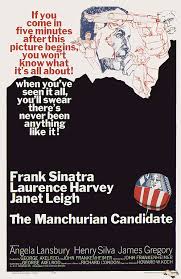 This is the poster advertising the film around the time it was made, suggesting that if someone shows up five minutes late, they will not know what is going on, suggesting that the film is very in depth and a lot of attention will be required from the audience in order for them to have the best experience from the film.
As briefly mentioned earlier, the main idea of the plot of The Manchurian Candidate is the son of a prominent, right-winged political family has been brainwashed to become an assassin as part of an international communist conspiracy.
The film has a modern remake as well, made in 2004 and directed by Jonathan Demme.
It is suggested that the modern version of the film is more sophisticated than the first one, which is to be expected as they have more technology to work with, however it is still important to remember that without the original the modern version could not exist, meaning it still has a lot of value in the film industry.
There are also contrasting ideas shown about society as a whole from the two versions of the same film, the older version shows obvious signs of racism, for example, ''mysterious and dangerous men from the east'' as well as an Asian servant and a single token black soldier.
The modern film eliminates these ideas of racism, showing a multi-racial society as well as a black protagonist.
In some ways that may not be immediately obvious, The Manchurian Candidate follows the recipe for an archetypal thriller. Lt Ben Marco is represented as the resourceful hero who initially did not want to be involved in any of the things he had to go through, having to use his resources and wit to regain his sanity and unravel his past.
He is represented as a tough character who has the respect of seemingly weaker men. Due to his service in the army, he is accustomed to danger and not afraid to assault his problems head on.
The film utilizes a number of different thriller sub-genres, these include; political thriller, paranoid thriller and psychological thriller.
As briefly mentioned earlier, the main idea of the plot of The Manchurian Candidate is the son of a prominent, right-winged political family has been brainwashed to become an assassin as part of an international communist conspiracy.
The film has a modern remake as well, made in 2004 and directed by Jonathan Demme.
It is suggested that the modern version of the film is more sophisticated than the first one, which is to be expected as they have more technology to work with, however it is still important to remember that without the original the modern version could not exist, meaning it still has a lot of value in the film industry.
There are also contrasting ideas shown about society as a whole from the two versions of the same film, the older version shows obvious signs of racism, for example, ''mysterious and dangerous men from the east'' as well as an Asian servant and a single token black soldier.
The modern film eliminates these ideas of racism, showing a multi-racial society as well as a black protagonist.
In some ways that may not be immediately obvious, The Manchurian Candidate follows the recipe for an archetypal thriller. Lt Ben Marco is represented as the resourceful hero who initially did not want to be involved in any of the things he had to go through, having to use his resources and wit to regain his sanity and unravel his past.
He is represented as a tough character who has the respect of seemingly weaker men. Due to his service in the army, he is accustomed to danger and not afraid to assault his problems head on.
The film utilizes a number of different thriller sub-genres, these include; political thriller, paranoid thriller and psychological thriller.
Die Hard With A Vengeance
Die Hard is another thriller that we have watched in class, the film begins with an anonymous man demanding John McLaine, who had no longer been working with the police force due to a suspension.
The anonymous male who refers to himself as Simon had set off a bomb in the city to get the attention of the police force, he then has ridiculous requests for McLaine, filling the role of a puppet master who wants to get inside the head of John, he is relatively successful in doing this. Simon gets John and the rest of the police force to obey his demands because he threatens that there will be more explosions if they do not obey his every demand.
When John gets himself into a spot of trouble he is saved by an unwilling man named Zeus, they eventually partner up to bring Simon down. In the middle of the film they both have to obey Simon's orders and they end up saving a lot of lives because despite Simon saying that he will stop the bombs if the tasks are completed, some of them were set off anyway.
Putting the pieces of the puzzle together Zeus and McLaine are able to bring simon down in an incredibly well executed death scene which includes the explosion of a helicopter mid air.
A lot of the tasks set by Simon were only put there in an attempt to lure Zeus and McLaine into their deaths however working together and putting their differences aside they were able to solve the puzzles and stay alive.
There is an iconic scene where Simon throws McLaine a container of pills, mocking him because he had requested some Aspirin which contains the location of where they are going to meet later on, this allows the police to intercept Simon and stop him.
Several techniques were used in this film to throw the audience off and make sure that they continue to pay attention the whole way through, for example, we were lead to believe that the actions of Simon were purely based on revenge, but we later find out that they were based on monetary gain instead and that he didn't even like his brother in the first place.
There was also a split second red herring used in the film because the audience was lead to believe that all the gold Simon had stolen would actually get blown up when really he was planning on claiming it all for himself.
Members of the audience may not have expected Simon to die, but he did, in a very well executed scene. This may be considered to be another red herring.
There was also a split second red herring used in the film because the audience was lead to believe that all the gold Simon had stolen would actually get blown up when really he was planning on claiming it all for himself.
Members of the audience may not have expected Simon to die, but he did, in a very well executed scene. This may be considered to be another red herring.
Tuesday, 3 December 2013
Source Code
Source Code is another thriller we have watched, it has a very unique and gripping plot which made it very interesting to watch from start to finish.
The film tries to use a fictional concept of ''source code'' which allows someone that has died to re-live the last 8 minutes of their life in a computer generated universe. The main character uses this technology to find a bomb in a fictional world, which eventually helps locate the bomber in the real world to prevent a second tragedy from taking more lives.
When the main character meets the leaders of the operation he quickly starts to disagree with what they are trying to do because he does not initially understand that he is no longer alive, he instead believes that he is being tortured and kept against his will, but when the intentions of the leaders become clear he quickly changes his mind and starts working with them in order to stop the bomber.
Shaun is told that he cannot save everyone on the train as they are already dead, and he is only reliving the tragic event through the power of source code. At the end of the film Shaun figures out a way to continue existing in the alternate universe past his barrier of eight minutes, where he will be able to restart his life with a woman that he has fallen for.
Many different techniques were used in order to deliver the plot of source code as effectively as it was delivered. Some of these include; several plot twists as well as a red herring.
To expand on these points, one of the most in depth red herrings I have seen so far was used in this film, we are reminded constantly through out the film that the time limit in the source code world is eight minutes. However, when he saves the train successfully and locates the bomber, he is able to figure out a way to live in the source code world past the eight minute time limit. The audience is lead to believe that this is impossible, so they think he will just go back to his cell where he is able to talk to the leaders of the operation, however he is able to stay.
Another plot twist is shown when when are told that it is impossible to send text messages to the past, however shaun is able to do this and this is how they locate the terrorist in the real world which they wouldn't be able to otherwise.
Overall source code was an interesting film with a plot that has more depth than a viewer may initially realize if they watch the film without paying attention.
The film tries to use a fictional concept of ''source code'' which allows someone that has died to re-live the last 8 minutes of their life in a computer generated universe. The main character uses this technology to find a bomb in a fictional world, which eventually helps locate the bomber in the real world to prevent a second tragedy from taking more lives.
When the main character meets the leaders of the operation he quickly starts to disagree with what they are trying to do because he does not initially understand that he is no longer alive, he instead believes that he is being tortured and kept against his will, but when the intentions of the leaders become clear he quickly changes his mind and starts working with them in order to stop the bomber.
Shaun is told that he cannot save everyone on the train as they are already dead, and he is only reliving the tragic event through the power of source code. At the end of the film Shaun figures out a way to continue existing in the alternate universe past his barrier of eight minutes, where he will be able to restart his life with a woman that he has fallen for.
Many different techniques were used in order to deliver the plot of source code as effectively as it was delivered. Some of these include; several plot twists as well as a red herring.
To expand on these points, one of the most in depth red herrings I have seen so far was used in this film, we are reminded constantly through out the film that the time limit in the source code world is eight minutes. However, when he saves the train successfully and locates the bomber, he is able to figure out a way to live in the source code world past the eight minute time limit. The audience is lead to believe that this is impossible, so they think he will just go back to his cell where he is able to talk to the leaders of the operation, however he is able to stay.
Another plot twist is shown when when are told that it is impossible to send text messages to the past, however shaun is able to do this and this is how they locate the terrorist in the real world which they wouldn't be able to otherwise.
Overall source code was an interesting film with a plot that has more depth than a viewer may initially realize if they watch the film without paying attention.
Friday, 22 November 2013
Sound
Sound is a key element in any successful modern film.
There are two types of sound that the audience will notice in
almost every film they watch. This is diegetic and non-diegetic sound.
Diegetic sound refers to sound that is within the world of the
text. This means sound that the characters within the film would be able to
hear, for example, if a dog is barking next to a character and the character
can hear the dog, that is an example of diegetic sound. Other examples can
include music and dialogue. Music is not exclusively an example of diegetic
sound however.
Non-diegetic sound refers to sounds that the audience can hear
that the characters within the film cannot, otherwise explained as sound that
is outside the world of the text. Common examples include voice overs and
soundtracks.
Another thing to keep in mind when analyzing sound within a
film is whether or not the sound is on or off screen.
''On screen sound'' is a term used to describe sound that can be
seen on the screen, whereas off screen sound is the opposite. For example, if
two people are having a conversation within a film and they are in focus, that
is on screen sound. However, if you hear a police car outside but the focus of
the camera is on the inside of the house and no police car can be seen, that is
off screen sound. Directors typically use off screen sound to create an effect
of suspense, they can also use this technique to save money, if they are able
to generate the sound of a police car for the scene they are trying to execute
without actually needing to show the police car they save themselves a lot of
work.
Analysis of Psycho
The film is introduced by an establishing shot, this starts from a general view of Phoenix, and goes to the particular which is a hotel room. This is where the audience is likely to believe that the main characters are being introduced, they are Marion Crane and her boyfriend Sam. The audience is told that they cannot get married because of financial instability and that they can only meet during Marion's lunch breaks.
The plot thickens when Marion is trusted to bank $40,000 which was given to her by an employer. Instead of doing what she was told with the money, she saw it as an opportunity to start a new life with Sam, by stealing the money and using it to cover their financial issues. As Marion is making her escape from the life she hates, she stops at The Bates Hotel, where she is soon to meet the Psycho.
The motel is ran by a quiet man ran named Norman Bates, the audience quickly find out that his mother controls a large part of his life and what he is able to do.
The audience is initially lead to believe that the film is about the forty thousand dollars and how Marion will be able to start a new life with it, however they are quickly proved wrong, and as the plot continues to develop the audience no longer has an understanding of what will happen, which allows Hitchcock to use devices of shock and suspense to their greatest potential.
We find out later on in the film that Norman actually killed his mother and her partner and later forced himself to act in a way that would make him feel like his mother still exists. Two separate personalities developed within him, one which was his own and another to represent his mothers. Any time Norman would meet a woman that he found attractive, his mother half would become furious with jealousy and he would be forced to kill them. That is the fate that struck Marion Crane. Norman is also forced to kill several other people as they come to look for him, anyone who tries to approach him eventually ends up dead which makes the audience wonder when his rampage will come to an end.
Several typical techniques were used by Hitchcock in this film to make it more effective. Firstly, a hugely effective plot twist is used when the audience is shown that it is not in fact Norman's mother killing people but Norman himself, under the effect of the second personality that has developed within him.
A red herring was also used relatively effectively, in the scene where Marion's sister wonders down to where Norman kept his mothers corpse, the audience is lead to believe that when she lets out a scream upon seeing the corpse, Norman would be able to locate her and kill her, but she is saved and Norman is captured for questioning.
This film strays away from the archetypal thriller recipe because it does not have a single hero, a lot of the people who the audience believes to be main characters actually end up dead in the first part of the film.
The title of the film being Psycho is another technique that could perhaps throw the audience off. This is because initially we are lead to believe that it is his mother who is a psycho, but we later find out that it is in fact Norman. Norman is initially presented as a normal man who has a possessive mother, the audience deduces this through the conversations they had. We later find out that it was just Norman talking to himself, presenting both of his personalities at the same time.
An interesting fact about the film is that it caused a lot of people to be too afraid to take showers after the shower death scene, including the actress of Marion herself.
The plot thickens when Marion is trusted to bank $40,000 which was given to her by an employer. Instead of doing what she was told with the money, she saw it as an opportunity to start a new life with Sam, by stealing the money and using it to cover their financial issues. As Marion is making her escape from the life she hates, she stops at The Bates Hotel, where she is soon to meet the Psycho.
The motel is ran by a quiet man ran named Norman Bates, the audience quickly find out that his mother controls a large part of his life and what he is able to do.
The audience is initially lead to believe that the film is about the forty thousand dollars and how Marion will be able to start a new life with it, however they are quickly proved wrong, and as the plot continues to develop the audience no longer has an understanding of what will happen, which allows Hitchcock to use devices of shock and suspense to their greatest potential.
We find out later on in the film that Norman actually killed his mother and her partner and later forced himself to act in a way that would make him feel like his mother still exists. Two separate personalities developed within him, one which was his own and another to represent his mothers. Any time Norman would meet a woman that he found attractive, his mother half would become furious with jealousy and he would be forced to kill them. That is the fate that struck Marion Crane. Norman is also forced to kill several other people as they come to look for him, anyone who tries to approach him eventually ends up dead which makes the audience wonder when his rampage will come to an end.
Several typical techniques were used by Hitchcock in this film to make it more effective. Firstly, a hugely effective plot twist is used when the audience is shown that it is not in fact Norman's mother killing people but Norman himself, under the effect of the second personality that has developed within him.
A red herring was also used relatively effectively, in the scene where Marion's sister wonders down to where Norman kept his mothers corpse, the audience is lead to believe that when she lets out a scream upon seeing the corpse, Norman would be able to locate her and kill her, but she is saved and Norman is captured for questioning.
This film strays away from the archetypal thriller recipe because it does not have a single hero, a lot of the people who the audience believes to be main characters actually end up dead in the first part of the film.
The title of the film being Psycho is another technique that could perhaps throw the audience off. This is because initially we are lead to believe that it is his mother who is a psycho, but we later find out that it is in fact Norman. Norman is initially presented as a normal man who has a possessive mother, the audience deduces this through the conversations they had. We later find out that it was just Norman talking to himself, presenting both of his personalities at the same time.
An interesting fact about the film is that it caused a lot of people to be too afraid to take showers after the shower death scene, including the actress of Marion herself.
Wednesday, 20 November 2013
No Country For Old Men
 No Country For Old Men is a criminal thriller based in the west. The film tells a story of a man who stumbles upon a drug deal gone wrong, where he finds a large sum of money that does not belong to him. The film has a villain driven plot because this man is now being chased by a hit man who shows no feelings of guilt or remorse, one could even say he gains a feeling of satisfaction every time he kills someone. themes of guilt and circumstance are examined in this film.
This film follows the archetype of a typical thriller as a ''civilian'' is forced to become the hero to save himself from a resourceful villain.
The main character of this film sends his wife to live with her mother in order to protect her when he finds out he is being followed
The film follows three main characters during its story, these are the villain, a regular citizen and a Sheriff. They are all caught up within the same story.
The villain, named Anton Chigurh, has been paid to capture the regular citizen, named Llewelyn Moss, who stumbled upon a drug deal gone wrong and has found himself a bag full of money, two million dollars to be exact. The Sheriff is stuck in between, his job is to stop the villain and obtain the money that has been stolen.
The ending of this film is very unusual as it is difficult to come to any real conclusion as to what happened, this is not typical of a thriller film. The hit man has been mortally wounded in a car crash, the Sheriff retired and the citizen ended up dead.
The MacGuffin in this film was the suitcase of money as all three main characters were in some way connected to it and wanted to get it. The audience does not know what happened to this money as the way in which Llewelyn was killed was not shown to the audience. This is another unusual aspect of this film because typically the audience is not concerned with the MacGuffin, but in this case it raises a few questions as the whereabouts of this MacGuffin are not clearly stated at the end of the film.
There was another character that entered the equation half way through the film, the private detective. A lot of characters within the film believed this character to be powerful and resourceful and they counted on him to stop Anton but we later find out that he is just another one for Anton's body count. This helps emphasize the power of Anton as a villain, implying that even the smartest most resourceful 'heroes' will be unable to stop him from finishing his mission and satisfying his desire to kill.
Wednesday, 6 November 2013
Additional Information On Alfred Hitchcock
Sir Alfred Hitchcock was born on the 13th of August 1899 and died on 29th of April 1980. What makes Hitchcock special is that not only was he the creator of the most successful films of his time, he was also a pioneer as he was the first to use many of the film techniques that are still used in modern films today.
Hitchcock began his career in Britain, having tremendous success with silent films and early talkies, however he decided to move to Hollywood to further pursue his career and receive multinational attention for his masterful work in film. He became a US citizen in 1955.
Hitchcock's films were shot in a way which emphasize fear, anxiety and suspense. These expert camera angles were often supported by innovative editing.
Given how unique his work was, he did receive the multinational attention which he was after, he managed to become a cultural icon for his time, and he remains an icon even today to people studying film and media.
His career spanned six decades, within which he was able to direct more than fifty feature films. Even today, British people say things like ''unquestionably the best film director to emerge from these islands'' making it clear that his impact on modern cinema is appreciated even today
To conclude, Hitchcock was one of the most successful directors in film history because he had a unique style of editing, innovative camera work, and was incredibly different from all the other directors that were active at the time.
Hitchcock began his career in Britain, having tremendous success with silent films and early talkies, however he decided to move to Hollywood to further pursue his career and receive multinational attention for his masterful work in film. He became a US citizen in 1955.
Hitchcock's films were shot in a way which emphasize fear, anxiety and suspense. These expert camera angles were often supported by innovative editing.
Given how unique his work was, he did receive the multinational attention which he was after, he managed to become a cultural icon for his time, and he remains an icon even today to people studying film and media.
His career spanned six decades, within which he was able to direct more than fifty feature films. Even today, British people say things like ''unquestionably the best film director to emerge from these islands'' making it clear that his impact on modern cinema is appreciated even today
To conclude, Hitchcock was one of the most successful directors in film history because he had a unique style of editing, innovative camera work, and was incredibly different from all the other directors that were active at the time.
Sunday, 3 November 2013
North by Northwest analysis.
North by Northwest is a thriller film directed by Alfred Hitchcock. It follows the life of Roger Thornhill. Roger is mistaken to be a secret agent by a criminal who is running illegal activities to get rich quick. The criminal sees Roger as a threat and thus goes to quite extreme lengths to try and eliminate him.
Roger Thornhill is not actually a secret agent, but assumes his new identity as George Kaplin and helps bring the criminal and his henchmen to justice.
Does North by Northwest follow the recipe of an archetypal thriller?
It is commonly stated that the recipe for a typical thriller contains a resourceful and powerful villain and a hero who is dragged into the story often against his own will. This is the exact plot of North by Northwest. Roger is not actually a secret agent, he works for an advertisement company, however he eventually does start to work with the police to bring the aforementioned criminal to justice and to clear his own name.
The character of Thornhill is never properly explained. His character intentionally does not have a lot of depth. This allowed Hitchcock to focus on the story itself, which was Thornhill trying to clear his name from all the crimes he was caught up in because of the men trying to get rid of him while believing that he is a secret agent.
Roger Thornhill is not actually a secret agent, but assumes his new identity as George Kaplin and helps bring the criminal and his henchmen to justice.
Does North by Northwest follow the recipe of an archetypal thriller?
It is commonly stated that the recipe for a typical thriller contains a resourceful and powerful villain and a hero who is dragged into the story often against his own will. This is the exact plot of North by Northwest. Roger is not actually a secret agent, he works for an advertisement company, however he eventually does start to work with the police to bring the aforementioned criminal to justice and to clear his own name.
The character of Thornhill is never properly explained. His character intentionally does not have a lot of depth. This allowed Hitchcock to focus on the story itself, which was Thornhill trying to clear his name from all the crimes he was caught up in because of the men trying to get rid of him while believing that he is a secret agent.
Friday, 25 October 2013
What is a MacGuffin?
The definition of a MacGuffin is something that the villain in a film cares tremendously about, and is willing to give up anything as long as he can get it. This can include money, power, or an item of significance to them. The audience usually doesn't care about these things.
MacGuffins are common in thrillers because the plot is villain driven a lot of the time. MacGuffins help develop a story and deliver it more effectively. There is no need to explain the decisions made by each character as it becomes more obvious, the villain is usually chasing the MacGuffin and the hero is usually trying to stop them from obtaining it.
The MacGuffin is often disregarded by the end of the film. This is because the audience switch their focus to whether or not the good guy can foil the bad guys plan, not whether or not the bad guy is successful in obtaining some money or successfully completing a drug deal, as two examples that can be used.
MacGuffins are common in thrillers because the plot is villain driven a lot of the time. MacGuffins help develop a story and deliver it more effectively. There is no need to explain the decisions made by each character as it becomes more obvious, the villain is usually chasing the MacGuffin and the hero is usually trying to stop them from obtaining it.
The MacGuffin is often disregarded by the end of the film. This is because the audience switch their focus to whether or not the good guy can foil the bad guys plan, not whether or not the bad guy is successful in obtaining some money or successfully completing a drug deal, as two examples that can be used.
Welcome to my media blog.
Hi, my name is Matas Vireikis and on this blog you will find what I have learnt about thrillers, how they are made and the techniques used to make them successful.
Thrillers we have studied so far include:
The Birds
North by Northwest
Psycho
Thrillers we have studied so far include:
The Birds
North by Northwest
Psycho
Rules and conventions of a thriller
Thrillers as a genre of film follow many set rules when they are being created. Firstly, they usually involve a powerful villain who is chasing a McGuffin (something that the villain cares tremendously about, something that is their goal within the world of that film, but something that may not necessarily interest the audience.)
This villain must be stopped by a resourceful 'hero' character, who may often times be someone who is dragged into the plot of the film against their own will. An example of this can be found in the film North by Northwest.
Most thriller films will include non diegetic sound and sound bridges to create a certain an atmosphere
The aim of a thriller is to grab the audiences attention. This could be done in various ways, for example, starting with an action scene without explaining what is happening to the audience will leave them wondering what the rest of the story will be about and they will be more likely to pay attention to the details of the film.
It is also important to not make the story overly obvious, techniques such as foreshadowing can be used to suggest what will happen, but it is important to build up the story to keep the audience interested instead of dropping all the information on them at one time.
This villain must be stopped by a resourceful 'hero' character, who may often times be someone who is dragged into the plot of the film against their own will. An example of this can be found in the film North by Northwest.
Most thriller films will include non diegetic sound and sound bridges to create a certain an atmosphere
The aim of a thriller is to grab the audiences attention. This could be done in various ways, for example, starting with an action scene without explaining what is happening to the audience will leave them wondering what the rest of the story will be about and they will be more likely to pay attention to the details of the film.
It is also important to not make the story overly obvious, techniques such as foreshadowing can be used to suggest what will happen, but it is important to build up the story to keep the audience interested instead of dropping all the information on them at one time.
Analysis of Hitchcock's ''The Birds''
<Remember to watch and analyse the trailer>
The basic plot of the film is as follows : A wealthy San
Francisco socialite pursues a potential boyfriend to a small Northern
California town that slowly takes a turn for the bizarre when birds of all
kinds suddenly begin to attack people there in increasing numbers and with
increasing viciousness.
In what ways is ''The Birds'' an archetypal thriller?
The birds is an archetypal thriller because it uses suspense and slow build up to tell the shocking story of how birds turn on mankind and attack them. The plot is delivered relatively slowly but when the birds start attacking the audience has no way of knowing how the story will actually end. There is usually an external threat to the protagonist(s), in ''The Birds'' it is nature, which is actually not typical within a thriller.
Hitchcock has given the characters nowhere to hide, meaning they are at the complete mercy of the birds.
however, there is a part of the birds that does not fit the idea of an archetypal thriller. The external threat in this film is nature, not a powerful villain with many minions and henchmen at his disposal. this is an interesting twist in the thriller genre.
There is also a well used example of dramatic irony found within The Birds, the lady who claims to be an expert when it comes to birds, does not believe that birds have been gathering and attacking people, she claims the idea to be outrageous, however the audience knows that it is true because of the schoolyard scene that was shown just beforehand.
When the birds begin to attack, the high angle shot is almost like showing the point of view of a pitiless God who does not want to intervene because he feels as though the characters involved do not deserve any sympathy for taking nature for granted.
It is often said that the thriller is a villain driven plot, however this is not true for the birds as there are no real villains, the threat comes from nature.
The ending of the film is also presented in an interesting and unusual way. It feels as though the film does not actually end. The ending scene is just the family surrounded by birds driving away from their home, we do not know what happens to them and we do not know whether the birds stop attacking or not, Hitchcock used this particular technique to give the impression of unending terror to the audience, with great success.
The birds are portrayed as characters who are flocking together to seek revenge upon mankind, because they had been abused for years. The lady who claims to love birds is interrupted by an order of three southern fried chickens, which is ironic because that is an example of birds being abused and mistreated despite the fact that someone who claims to like them is the focus of the scene.
There is also a well used example of dramatic irony found within The Birds, the lady who claims to be an expert when it comes to birds, does not believe that birds have been gathering and attacking people, she claims the idea to be outrageous, however the audience knows that it is true because of the schoolyard scene that was shown just beforehand.
When the birds begin to attack, the high angle shot is almost like showing the point of view of a pitiless God who does not want to intervene because he feels as though the characters involved do not deserve any sympathy for taking nature for granted.
It is often said that the thriller is a villain driven plot, however this is not true for the birds as there are no real villains, the threat comes from nature.
The ending of the film is also presented in an interesting and unusual way. It feels as though the film does not actually end. The ending scene is just the family surrounded by birds driving away from their home, we do not know what happens to them and we do not know whether the birds stop attacking or not, Hitchcock used this particular technique to give the impression of unending terror to the audience, with great success.
The birds are portrayed as characters who are flocking together to seek revenge upon mankind, because they had been abused for years. The lady who claims to love birds is interrupted by an order of three southern fried chickens, which is ironic because that is an example of birds being abused and mistreated despite the fact that someone who claims to like them is the focus of the scene.
Subscribe to:
Posts (Atom)